
Permanent mould casting
Permanent mould casting, also called gravity die casting, is a process in which molten metal is poured into a reusable metal mould under gravity or low pressure. It gives denser castings and better surfaces than sand casting, and suits aluminium and copper alloy parts in medium to large series that must be heat treated or pressure tight.
Request a quote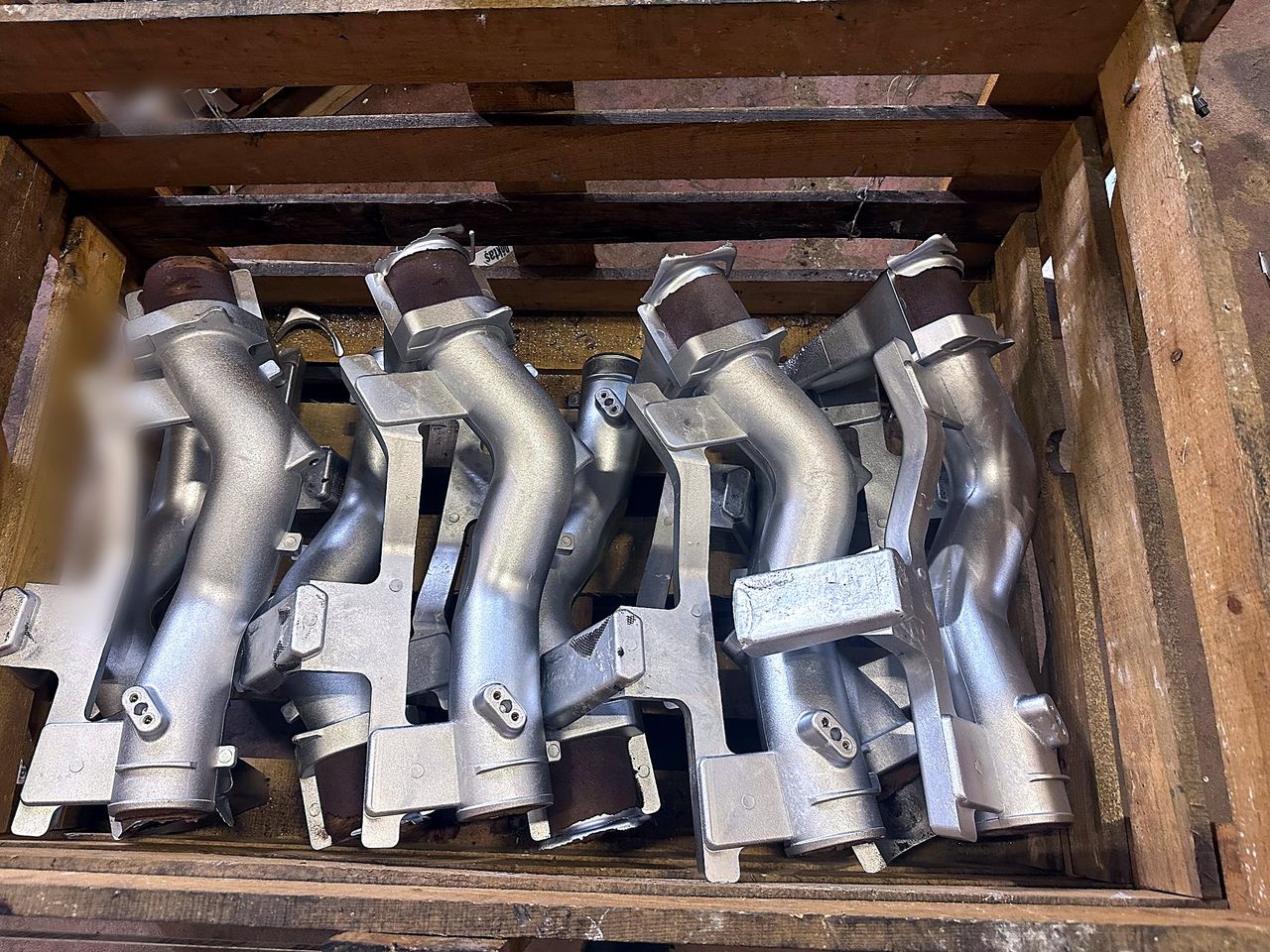
At a glance
Typical parts
- Aluminium housings and manifolds that must be pressure tight
- Wheels, pulleys and impellers
- Pistons and cylinder heads
- Hydraulic and pneumatic components
- Brass and bronze fittings and valve parts
Quantities
- Medium to large series
Inspection
- Alloy composition by spectrometer
- Test bars before and after heat treatment
- Full first article
- X-ray, PT, leak or pressure test if specified
Documents
- EN 10204 3.1 certificate
- Heat treatment record where applicable
- Dimensional report
How permanent mould casting works
A metal mould, usually made of tool steel or cast iron, is coated with a refractory dressing and preheated. Molten metal is poured in by gravity, often with a tilting machine, or pushed up from below by low pressure (low-pressure die casting). Sand cores can be inserted for internal cavities. Because the metal mould extracts heat quickly, the castings have a fine-grained, dense structure.
Quality checks and documents for permanent mould castings
Alloy composition is checked by spectrometer and mechanical properties on test bars, before and after heat treatment. First articles are measured in full. Depending on the specification, castings are X-rayed for porosity, penetrant tested, and leak or pressure tested.
Standard documents are a material certificate to EN 10204 3.1, a heat treatment record where applicable and a dimensional report. More on the quality page.
Materials for permanent mould casting
Aluminium
EN 1706
- EN AC-AlSi7Mg0.3 (G-AlSi7Mg)
- EN AC-AlSi10Mg
- EN AC-AlSi12
Copper alloys
EN 1982
- CuZn39Pb1Al-C (brass)
- CuSn10-C
- CuAl10Fe5Ni5-C
In EN 1982 the suffix GM identifies permanent mould castings, for example CuZn39Pb1Al-C-GM. There is no fixed size or weight limit. Send us your drawing and we will define the right production route for the part and confirm feasibility.
Is this the right process?
When permanent mould casting is the right choice
- The part is aluminium or a copper alloy, in medium to large series
- The part must be heat treated (T6), welded or pressure tight
- Better surface and mechanical properties than sand casting are needed, at lower tooling cost than die casting
When another process is better
- Very high volumes of thin-walled parts: die casting has shorter cycle times and allows thinner walls
- Small quantities or very large parts: sand casting avoids the cost of a metal mould
- Iron and steel: permanent moulds are mainly used for non-ferrous alloys; use sand casting
Related pages
- CNC machiningCNC turned, milled and ground parts, EDM, laser and waterjet cut parts from machine shops in Türkiye, from prototypes to series, with dimensional reports.
- Secondary operationsHeat treatment, galvanising, powder coating, KTL e-coating, painting and assembly for cast, forged and machined parts, managed by QProcess in the same order.
- Machinery and equipmentMachine bases, housings, shafts, gear blanks, guides and plastic wear parts for machinery and equipment manufacturers, produced by manufacturers in Türkiye.
- Commercial vehicles and automotiveHubs, brackets, die cast housings, shafts and turned parts for commercial vehicle, trailer and automotive tier suppliers and the aftermarket, from Türkiye.
- Other industriesCast, forged, machined and plastic parts for pumps and valves, hydraulics, rail, material handling, industrial automation, robotics and marine equipment.
Frequently asked questions
What is the difference between permanent mould casting and die casting?
In permanent mould casting the metal fills the mould by gravity or low pressure, while die casting injects it at high speed and pressure. Permanent mould castings are denser and can be solution heat treated and welded. Die casting allows thinner walls and shorter cycle times at high volumes.
Can permanent mould castings be heat treated to T6?
Yes. Alloys such as EN AC-AlSi7Mg0.3 are routinely cast in permanent moulds and heat treated to T6 for higher strength. This is one of the main reasons to choose permanent mould casting over die casting.
Can you produce hollow parts in permanent moulds?
Yes. Internal cavities are formed with sand cores placed in the metal mould. This is sometimes called semi-permanent mould casting and is common for housings and manifolds.
Send your drawing. You get a quotation in 3 to 5 working days.
Your drawings are handled confidentially; NDA on request.